
What Scotland County Probate Covers
North Carolina probate in Scotland County is centered on estates. A probate file may involve opening an estate, proving a will, qualifying a personal representative, appointing a collector for a small estate, giving notice to creditors and heirs, filing inventories, filing accountings, receiving or waiving rights, distributing property, and closing the estate. Some special proceedings and guardianship matters also pass through clerk-supervised processes, though adult guardianship can have its own forms and privacy limits. Trust papers do not become court records just because a private trust exists. They appear in court records only if a dispute or related proceeding is filed.
For Scotland County, the probate venue is the Clerk of Superior Court at the county courthouse. The official North Carolina estates help topic says elected clerks and assistant clerks hold most estate hearings and preside over most estate cases. If someone files a caveat, which is a challenge to the validity of a will, the caveat is heard by a Superior Court judge. That is why Scotland County probate records can involve both the clerk's probate role and the Superior Court Division when a will contest arises.
The official estates help topic is the source for the clerk's probate role in Scotland County.
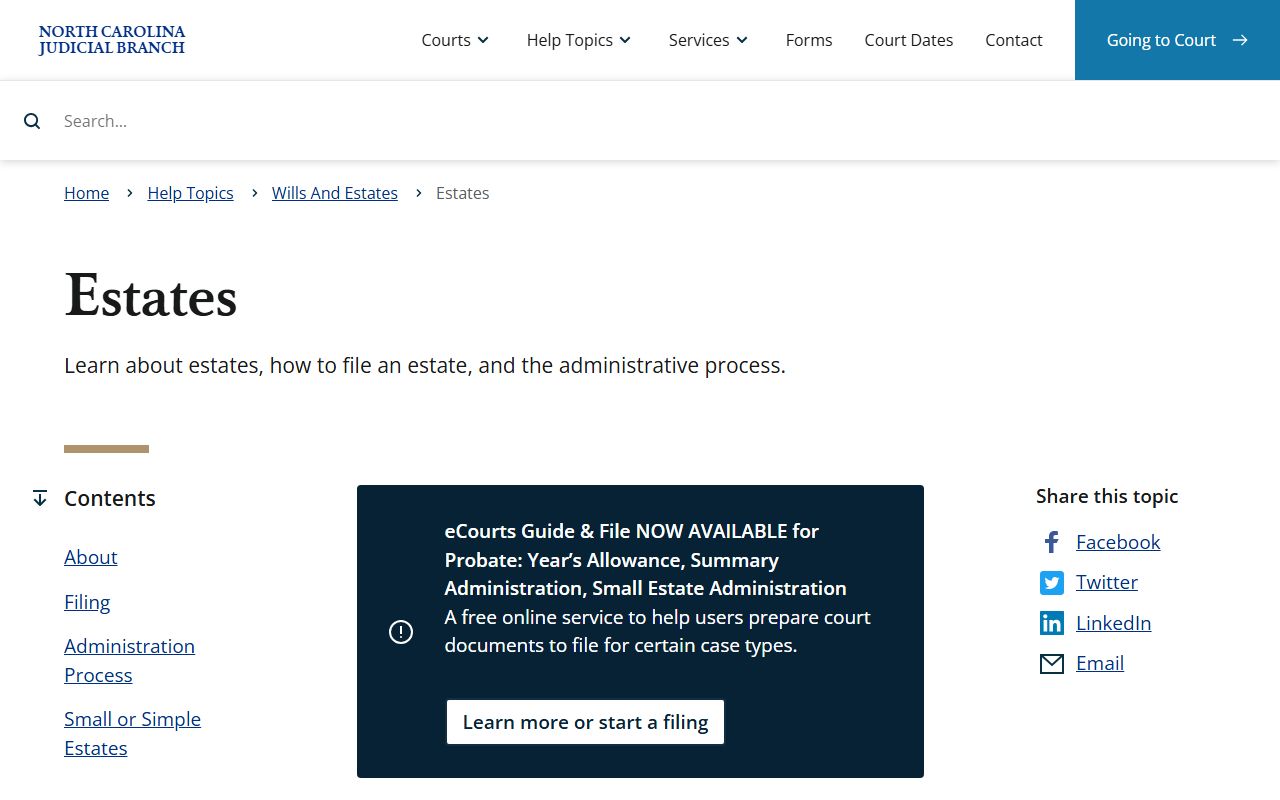
The statewide estates page helps explain why the local Clerk of Superior Court is the office to contact for estate filings and hearings.
Scotland County Probate Terms
Estate files use short legal terms that can be easy to mix up. These definitions keep the probate record readable when looking at an application, inventory, accounting, notice, or order. The terms also help separate a routine estate administration from a contested will case or a guardianship matter.
- Testator
- The person who made a will before death.
- Executor
- The person named in a will to carry out estate duties after court qualification.
- Personal representative
- A general term for an executor, administrator, or other person qualified to manage an estate.
- Intestate
- Dying without a valid will, which means heirs and estate steps are controlled by statute.
- Guardianship
- A court-supervised arrangement for a person who needs legally authorized help with personal or financial affairs.
- Conservatorship
- A term used in some states for property management; North Carolina research here points to guardianship and clerk-supervised proceedings instead.
Search Scotland County Probate Records
Start public Scotland County probate records research in the North Carolina eCourts Portal when a public estate or special proceeding should have a case summary. The official Portal training page says Smart Search may show causes of action for probate matters, case events, dispositions, hearings, and financial information when those fields are public and available. Use Scotland County as the location filter. Estates and nonconfidential special proceedings are the most relevant case-type filters.
- Open Smart Search in the eCourts Portal and set the location to Scotland County when available.
- Search by decedent, personal representative, heir, petitioner, or case number if known.
- Use Estates or Special Proceedings filters to reduce unrelated civil, family, or criminal results.
- Review the case summary for filing date, case status, events, hearings, and parties.
- Contact the Clerk of Superior Court for complete files, certified copies, older estate records, or documents not viewable online.
The Judicial Branch court-records help page states that civil, special proceeding, and estates case information can also be accessed on public self-service terminals in any clerk's office. The full file is viewed at the clerk's office in the county where the case is located.
The official court-record access page is a source for the public terminal and in-person estate-file path.
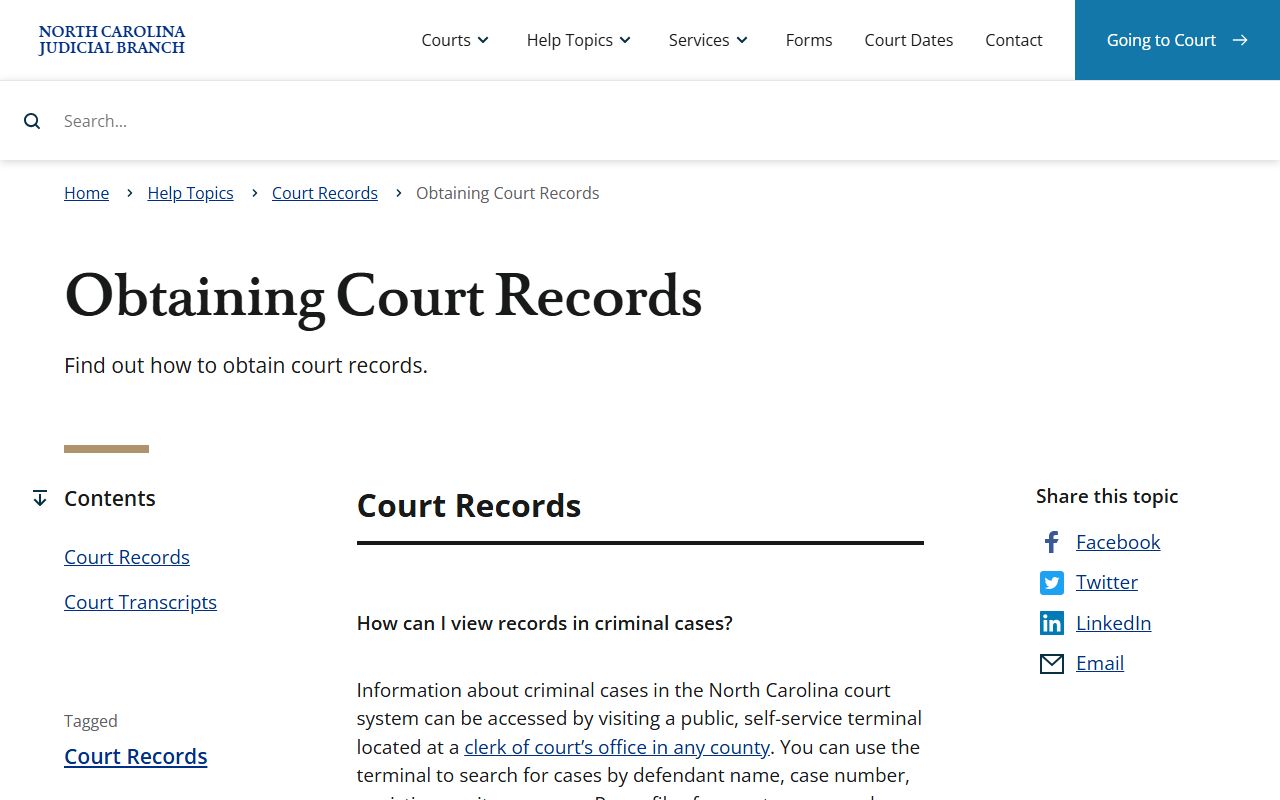
Online search is a starting point, but the clerk remains the source for full estate files and certified probate copies.
Scotland County Probate Contact Cards
There is not a separate Scotland County probate court building in the research. The proper probate contact is the Clerk of Superior Court acting as probate judge for estates. The same courthouse also connects users to Superior Court when a probate issue becomes a will caveat or other matter assigned to a judge.
Clerk of Superior Court acting as probate judge for estates
212 Biggs Street
Laurinburg, NC 28352
910-266-4400
Monday-Friday, 8:30 a.m.-5:00 p.m.
Scotland County Courthouse mailing address
P.O. Box 769
Laurinburg, NC 28353
910-266-4400
Call before mailing estate copy requests or payment.
Scotland County Probate Fee Research
A Scotland-specific probate filing fee schedule was not located in the official local sources reviewed. The research found that some official small-estate guidance from other North Carolina counties lists a filing fee, but that amount was not verified for Scotland County and should not be published here as a local probate fee. The safer access rule is to confirm the current cost with the Clerk of Superior Court before filing or requesting certified estate copies.
| Item | Amount |
|---|---|
| Original estate opening or probate application | Not located in Scotland-specific official research |
| Small-estate affidavit filing | Not verified for Scotland County |
| Certified estate copy | Not located in Scotland-specific official research |
| Guardianship or special proceeding filing | Confirm with Clerk of Superior Court |
Use the courthouse phone before mailing an estate filing or copy payment. Court costs can change, and estate fees may depend on the form, case type, property value, or copy certification requested.
What Scotland County Probate Records Show
A Scotland County probate record may show the decedent's name, filing date, case number, estate type, personal representative, heirs, applicants, notices, claims, inventories, accountings, receipts, distributions, orders, and closing documents. Small-estate files may show a personal-property affidavit, family history affidavit, original will if one exists, death certificate, and resident process agent form if the applicant is not a North Carolina resident. The Portal may show summary events and party information, while the clerk's file contains the underlying documents available for inspection or copying.
| Search Field | Use in Scotland County Probate Search |
|---|---|
| Location | Select Scotland County to avoid statewide name matches. |
| Case Type | Use Estates or nonconfidential Special Proceedings when available. |
| Party Name | Search decedent, personal representative, heir, petitioner, or other party. |
| Case Number | Use the court case number when a file or prior notice provides it. |
| Filing Date Range | Narrows estate openings and older case groups. |
| Case Status | Helps separate open matters from closed or disposed estate files. |
The record-keeping statute at N.C.G.S. 7A-109 is relevant because it requires clerks to keep court records, files, dockets, and indexes, and makes those records open during regular office hours unless another law prohibits access.
The record-keeping statute helps explain why public estate indexes and clerk-office inspection are separate parts of probate access.
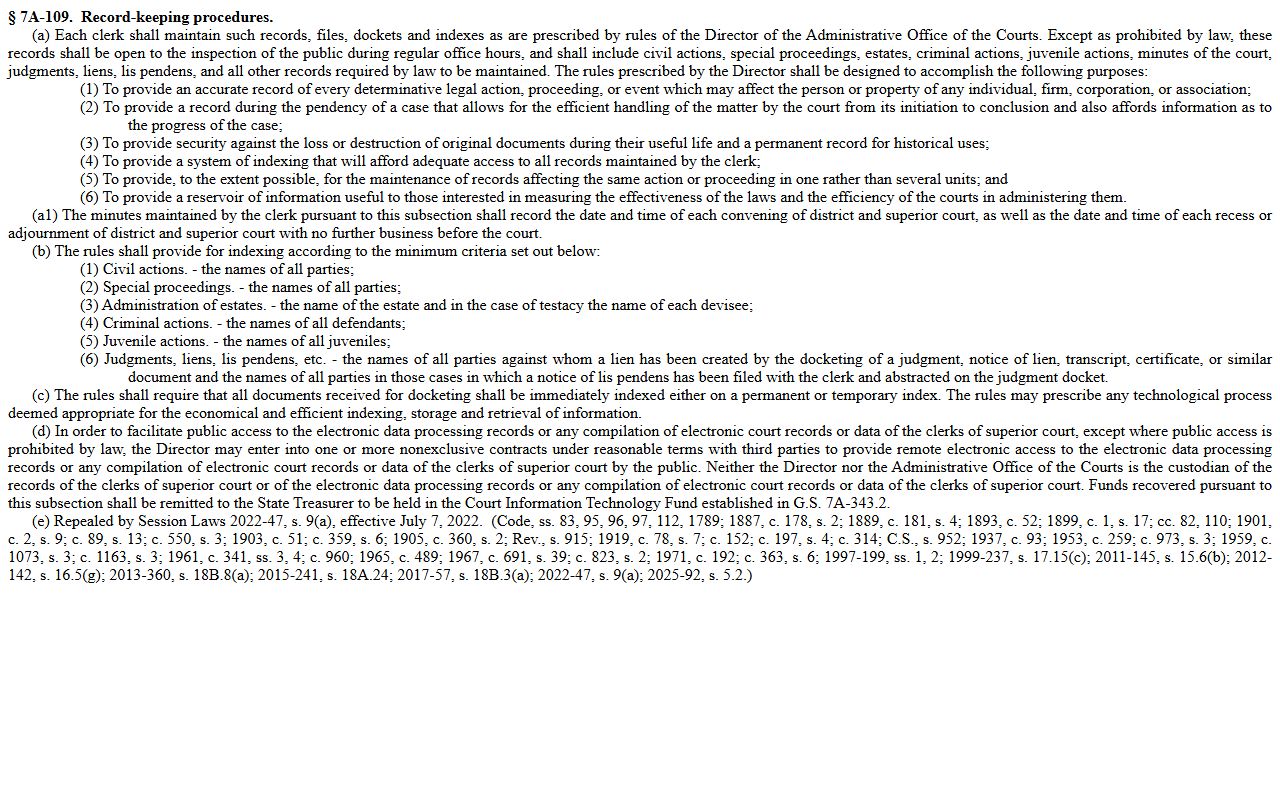
Estate records are public only to the extent no sealing rule, guardianship limit, juvenile rule, or protected personal information rule blocks release.
Restricted Scotland County Probate Records
Most routine estate administration is public, but probate-related files can include sensitive material. Guardianship, mental health, minor-related information, sealed filings, financial account numbers, Social Security numbers, and medical facts may be restricted or redacted. The county Register of Deeds redaction rules are not probate rules, but they show the same public-record concern: personal identifiers should not appear in public online record images unless law requires it or the data is redacted to no more than the last four digits.
Small-estate access has its own threshold facts. For deaths on or after October 1, 2009, a small-estate personal-property affidavit may apply when personal property, less liens and encumbrances, does not exceed $20,000, or $30,000 when the surviving spouse is the sole heir or devisee. At least 30 days must have passed since death, and no personal representative application can be pending or granted in any jurisdiction. The clerk can confirm which forms and proof are needed for a Scotland County filing.
Note: A public case summary does not guarantee every probate document can be viewed online or copied without clerk review.